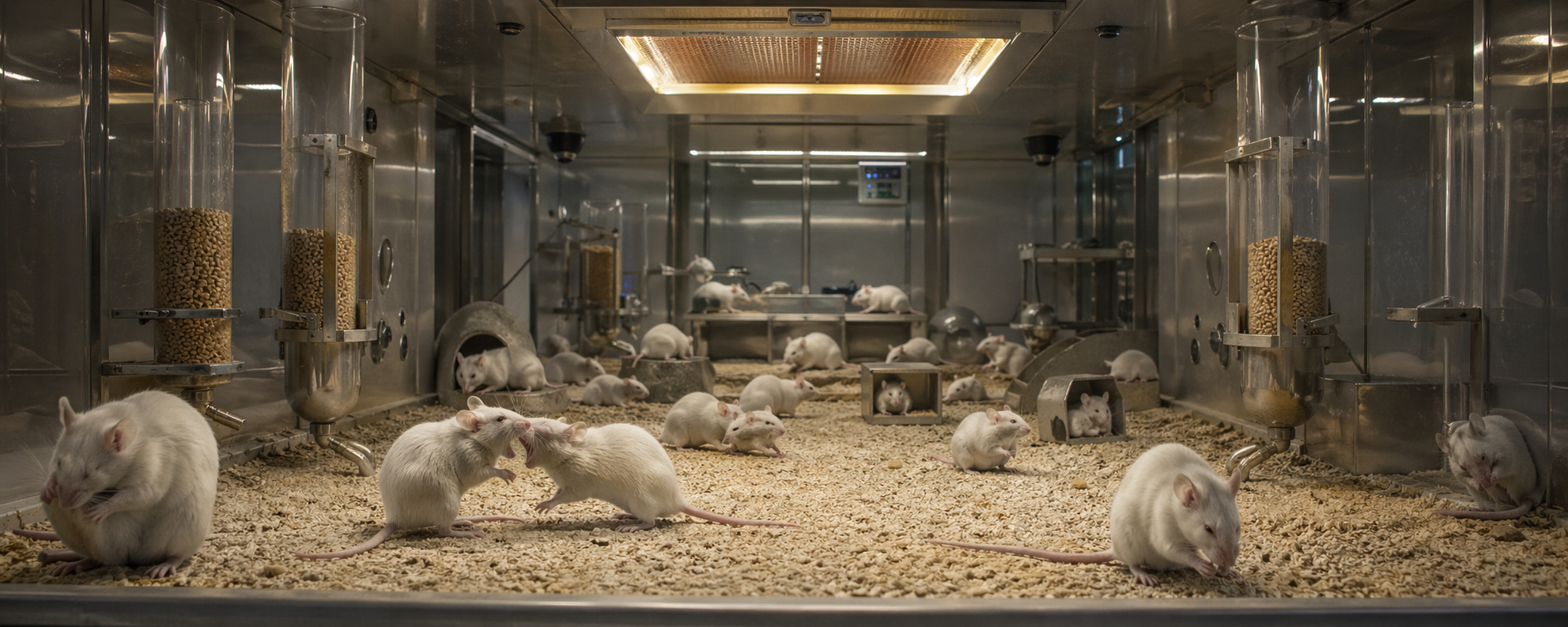
The story of Universe 25 is uncomfortable because it begins with something that sounds almost ideal.
A world with enough food, water, shelter, safety, and comfort. For mice, at least, John B. Calhoun’s experiment looked like a tiny engineered paradise.
Started on July 9, 1968, the study placed eight healthy mice into a carefully controlled enclosure. At first, the result seemed like success. The colony grew quickly, reaching around 620 mice by Day 315 and roughly 2,200 by Day 560.
On paper, the system worked.
There was no famine, no predator, no obvious external disaster waiting at the edge of the cage.
And yet the colony collapsed.
The Collapse of Paradise
The breakdown was not material.
It was social and behavioral.
Young males struggled to find roles. Some became aggressive, while others withdrew completely. The so-called “Beautiful Ones” avoided conflict, mating, parenting, and social life, spending their time grooming themselves while the colony around them disintegrated.
Females began abandoning or attacking their young. Infant mortality rose sharply. Reproduction eventually stopped entirely, with the last birth recorded around Day 920. By Day 1780, the experiment ended with only a small number of abnormal survivors left.
The important lesson is not that mice are humans in miniature.
They are not.
Universe 25 should not be treated as a direct prophecy about human civilization. But it does raise a useful and unsettling question.
What happens when material abundance removes hardship but does not create meaning, competence, stable social roles, or resilience?
The Paradise Paradox
That is where the “Paradise Paradox” becomes interesting.
Modern technology promises to make life easier in almost every direction. Navigation tools mean we do not need to learn maps. Search engines mean we do not need to remember as much. AI systems can summarize, calculate, write, organize, translate, and increasingly think through problems on our behalf.
Much of this is genuinely useful.
Nobody becomes wiser because they had to suffer through bad bureaucracy or manually do pointless tasks that a machine can handle better.
But not all friction is pointless.
Why Useful Friction Matters
Human beings learn through challenge, error, and surprise.
The brain is not just a storage device; it is a prediction system that updates itself when reality disagrees with expectation.
If life becomes too smooth, too automated, and too buffered from difficulty, we risk removing the very conditions that train judgment.
A society can become more comfortable while its people become less practiced at dealing with uncertainty.
This is the deeper risk behind the Paradise Paradox.
The same tools that reduce effort can also reduce practice.
If GPS always guides us, we may lose orientation. If the internet always remembers for us, we may weaken our own memory and reasoning habits. If AI always produces the first draft, the summary, the argument, and the decision, we may slowly forget how to wrestle with ideas ourselves.
Comfort as a Pacifier
That does not mean technology is bad.
That would be too simple, and also slightly ridiculous to say while using a global computation network to complain about global computation networks.
The real issue is design.
We need to distinguish between useless suffering and useful challenge. A good society should remove unnecessary misery, but it should not remove every form of effort that builds competence.
The danger is not paradise itself.
The danger is paradise as a pacifier.
A comfortable society can become fragile if it no longer trains people to handle discomfort, ambiguity, disagreement, responsibility, or risk.
And the irony is that this softness arrives at the same time as our tools become more powerful.
AI, biotechnology, automation, and global networks create enormous opportunities, but also new kinds of danger. We may gain more power while losing some of the habits needed to manage that power wisely.
Building Better Progress
Universe 25 is not a map of our future, but it is a useful warning label.
Abundance alone does not guarantee health. Comfort alone does not create purpose. Safety alone does not produce maturity.
A functioning society needs roles, learning, responsibility, social bonds, and enough meaningful challenge to keep minds and communities alive.
The answer is not to reject progress.
It is to build better progress.
We should design technologies that support human competence instead of replacing it wherever possible. AI should help people think, not quietly turn thinking into an optional hobby.
Education should preserve struggle in a healthy form. Communities should offer belonging and responsibility, not just consumption and distraction. Automation should remove pointless tasks while leaving room for skill, judgment, and growth.
Paradise Needs Purpose
Paradise, if we ever build it, should not be a cage with better snacks.
It should be a place where comfort does not erase courage, where tools do not replace wisdom, and where abundance still leaves enough meaningful friction for people to grow.
So yes, build paradise.
Just make sure it comes with purpose, responsibility, and a few useful problems.
And, naturally:
Don’t Panic!