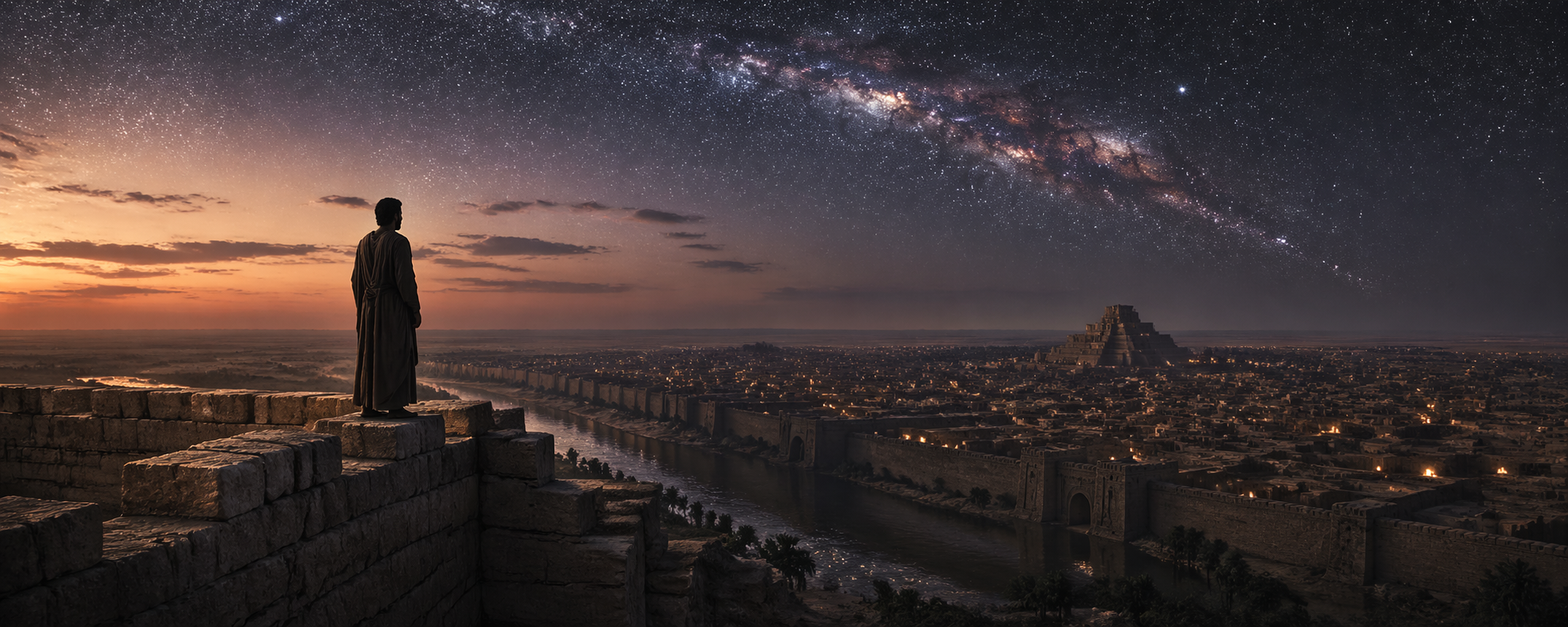
Humans occupy a peculiar spot in the cosmos: tiny, transient, yet endlessly preoccupied with meaning.
Our awareness of mortality is both a curse and a catalyst. It pushes us toward questions that no star or black hole seems to care about.
Gilgamesh and the Idea of Legacy
The ancient tale of Gilgamesh captures this tension neatly.
Facing his own death, Gilgamesh discovers that while individual life fades, the cities and cultures we build — like his beloved Uruk — can endure.
Legacy, then, becomes a form of cosmic defiance.
It is a way to whisper, “I was here,” long after the body turns to dust.
Meaning in an Indifferent Universe
This search for meaning is not just nostalgia or vanity.
It is a response to the vastness around us — a vastness that makes human life feel both fragile and absurd.
We know the universe will outlast us by incomprehensible spans of time, and yet we still try to leave marks that future generations might recognize.
That is where the philosophical tension lies: how to situate human purpose against the indifferent backdrop of stars and galaxies.
Why Preservation Matters
Looking forward, this urge to preserve heritage takes on new urgency.
Humanity faces existential threats that could erase our story entirely.
And yet, even in contemplating such risks, we reaffirm our commitment to meaning-making.
Whether through art, culture, or scientific endeavor, we build not only for ourselves but for those who might come after us.
It is a kind of hopeful stubbornness, a refusal to let the cosmos’ indifference dictate our narrative.
Persistence Over Immortality
In the end, the human legacy is less about immortality and more about persistence.
It is an ongoing conversation with time itself.
We may be small, ephemeral creatures, but our creations, our stories, and even our questions carry a peculiar kind of weight.
Like Gilgamesh’s walls around Uruk, they stand as monuments to the fact that we once dared to care.
And maybe that is enough. 😏